Thursday, August 20, 2015

The gems of South Bombay vol 5 - Shree Thaker Bhojanalay

Gujaratis (or Gujjus as they are popularly known) have always been one of the most prominent communities of Bombay. In terms of influence on the city's culture, they are second only to Maharashtrians. Even the city's Hindi dialect (Bambaiyya) has a large number of Gujarati loan words. Known primarily as a business community, they wield significant economic clout in the city. Most areas in Bombay have significant Gujju populations, but Kandivali, Ghatkopar and parts of South Bombay are undisputed Gujarati bastions.

When not chasing the next lucrative business idea, Gujjus are known for traveling the world (does the phrase 'Patel snap' ring a bell?) and dining out. On any given weekend in the city, one is likely to find Gujarati families queuing up at the popular food stalls or occupying majority of the tables at most restaurants. So much so, that most restaurants in the city have now expanded the vegetarian sections in their menu (most Gujaratis are vegetarians) and some even have separate Jain menus.

But while South Indian, Indianized Mexican and Italian are the most popular weekend cuisines among the Gujaratis of Bombay, how about their own food? While an authentic Gujarati meal is best experienced at a dining table in a Gujarati household, there is one good option if you want to try the cuisine while eating out. That is the Gujarati Thali. As the name suggests, it’s a one-person meal (obviously vegetarian in this case), which in most cases is an eat-all-you-can combination of Rotis, Dals, rice and countless sides and desserts.

There are a large number of restaurants offering the Gujarati Thali in Bombay. And while there is a restaurant serving the Gujju Thali in most localities in the city, the largest number can be found in South Bombay. Not surprising, given the fact that many of its areas like Walkeshwar, Girgaon and Kalbadevi are Gujju-dominated. While which one of these is the best can be a matter of great debate among Gujjus and non-Gujjus alike, my vote goes to a certain 'Shree Thaker Bhojanalay'.

Thaker has been at the top of the ratings on restaurant review sites and TripAdvisor for several years now. And while that is not the last word on the quality of food at a restaurant, a stellar score across websites after  thousands of ratings and hundreds of reviews makes the case in its favor really strong. In fact, for the longest time, Thaker was Mumbai's restaurant #1 on TripAdvisor.

Finding this place is nothing short of a treasure hunt though. Tucked away in a tiny alley of Kalbadevi called Dadiseth Agiary Lane, this one is hard to find even with the help of Google Maps.
I have been here several times and it’s only after three or four visits that I could get here without stopping to ask for directions. But don't let this deter you - the reward at the end of this search is good enough! What's more, once you're in the right lane, a significant landmark in the city's history greets you on your way to the restaurant - Dadiseth Agiary, which lends its name to the lane, is the oldest Zoroastrian fire temple in the city!


The restaurant itself is on the first floor of one of the typical chawl buildings in the area and you have to spot the board announcing its presence at the building entrance if you don’t want to miss it. As you climb the creaking stairs, framed proofs of accolades gathered over the years greet you.


The air-conditioned and brightly lit interiors are in complete contrast to the dark corridors one passes through before entering. The staff, despite being super-busy at mealtimes seems to be trained in Gujarati hospitality, which makes dining here an especially pleasant experience.

Ordering can't get any simpler than at Thaker's. They have no menu as the standard Thali of the day is the only thing they serve. You get seated and a stainless steel plate with as many as ten bowls is dropped on your table. At this point it’s all empty and you have no idea of the assault that is about to begin.


Over the next five minutes, the large plate and the bowls begin to fill up. It’s hard to keep track of all that is served but here's most of it.

The Sides

- Kachori
- Dhokla
- Pakoda
- Chutneys (I could count at least four)
- Aachar (Pickle)
- Salad
- Farsan
- Papad
- Dahi Vada

The vegetable curries

- Potato
- Cabbage
- Mixed lentils
- Greens

The Dals

 - The typical Gujju sweet variant
- The standard savory dal

The Rotis (Three to four types including Puris)

The desserts

- Puran Poli
- Aamras


That is what it looks like after one round by the servers. And while it looks like a lot already, what the picture does not capture is the virtual (and persuasive) conveyer belt that the waiters form as they keep refilling each and every item on the plate. It's all really good and it’s only after you fear having no place for dessert, that you finally ask them to stop. And there's still that heap of rice to finish.


By the time you've finished the desserts, getting up to go to the wash basin looks like a daunting task. But as you drag yourself back through the dark corridor and dingy staircase, you know for sure that you will return to subject yourself to this again

Thursday, March 5, 2015

The gems of South Bombay vol 4 - The Kerala restaurants of Fort

South Bombay is mostly inhabited by communities which migrated to the city in its early days. Maharashtrians who came from other parts of the state and who have not moved to the suburbs, Gujarati business families, affluent Marwaris and Punjabis, Goan and East Indian Catholics and the Muslims of the Byculla to VT belt. Keralites or 'Mallus' as they are commonly called, have never formed a major part of its population.

Mallu-owned restaurants serving authentic Kerala cuisine are a big part of the crowded food scene of the Fort area of South Bombay though. Part of this can be explained by the demand created by Keralites working in offices in the area. But a bigger reason for these restaurants coming into existence was the mad rush of youth from Kerala stopping over in Bombay on their way to work in the Middle East. While that steady clientele has now dwindled, with major airlines now flying to the Gulf directly from Kerala, many of the restaurants have survived to this day. When I counted last, there were at least seven Kerala restaurants in the Fort area, some of them located right next door to each other and still managing to draw packed houses at lunch. I have eaten at most of these but will introduce the three that I like best in this post.

Hotel Deluxe takes some finding, located in a small lane behind the Citibank building in Fort. An easy way to look for it is to get to the more famous Mahesh Lunch Home and enter the adjacent lane. It serves a long list of Kerala specialties in addition to a killer Sadhya meal for lunch. It shares the lane with its arch rival 'Taste of Kerala' which is its main competitor for the title of the best Kerala restaurant of Fort.

 
One fun aspect of Kerala cuisine is pairing the breads with the many curries/stews/roasts. Idiyappam is a bunch of steamed rice vermicelli usually served for breakfast with chutneys. It is my favorite among all the various sources of starch that are part of the Kerala food universe. Hotel Deluxe is kind enough to serve Idiyappams all day and I was more than glad to order it one evening with their superb Chicken Roast. I don't know if this is the ideal combination, but it sure worked for me. The fiery hot Roast loaded with green chilies and curry leaves was perfectly complimented by the light Idiyappams.

 
 Sadhya means banquet in Malayalam and is a term used to describe a vegetarian meal served on a banana leaf. It is a feast served on festivals like Onam and occasions like weddings and religious ceremonies. The number of items served on the leaf varies along with the significance of the occasion. At Hotel Deluxe, the biggest Sadhya is served on Onam and getting a seat at the restaurant during the festival is near impossible. A smaller but sufficiently elaborate Sadhya is served on Sundays, while a basic Sadhya with the essentials is on the menu on weekdays for lunch.

I tried the scaled down Sadhya at Hotel Deluxe on a weekday lunch with two of my colleagues and had absolutely no complaints. Here is all that was served

Boiled brown rice
Thoran (sauted cabbage with grated coconut)
Avial
Pineapple Pachadi (a sweet Khichadi)
Olan (a preparation made with pumpkin, coconut milk and ginger)
Sambar
Rasam
Garlic Pickle
Puliyinchi (a paste made of ginger, tamarind, green chilies and jaggery)
Pappadam
Parippu Pradhaman (green gram Payasam)


 This mini version was quite the feast as well, what with the waiters constantly refilling items on the leaf. Wonder what Sundays and Onam are like!!

While the Sadhya lunch is vegetarian, the fish and meat items can be ordered separately and I really wanted to try Karimeen (Pearl Spot), a fish which is very popular in Kerala and is found in large quantities in its backwaters. The whole fried Karimeen at Hotel Deluxe is loaded with spicy marinade and costs more than anything else on the menu, but is worth a try.
 

Taste of Kerala is the only-so-slightly more upmarket next door neighbor to Hotel Deluxe. The menu here is very similar to the neighboring eatery - the banana leaf vegetarian lunch and a long list of meat and fish specialties - but it also serves Chinese and North Indian fare in a bid to attract a wider clientele. It obviously makes sense to ignore these new additions and head straight 'South'.

Appams are almost synonymous with Kerala cuisine and are usually paired with a stew. At Taste of Kerala, the Appams are made fresh at a counter in the dining area itself. And they are best enjoyed with the Fish Naadan Curry. This is basically chunky pieces of Kingfish (Surmai) cooked in a curry made with thick coconut milk. Using your Appam to soak the last bits of curry is a joy any Kerala food experience would be incomplete without.

 
Taste of Kerala serves some beef preparations as well, but you will not find these on the menu. The reason according to them is to avoid spooking customers. Ask one of the waiters however, and they'll list the Taste of Kerala beef specialties in characteristic style. Beef Chilly is a big favorite among Keralites and is commonly served in the very popular toddy shops in the state. Taste of Kerala serves a great version and it is best had with the flaky, layered Kerala Parotta.

 
Tapioca, known as Kappa in Malayalam is a popular source of food in Kerala. It is eaten as an accompaniment with meat and fish curries and chips are also made out of it.  Kappa Biryani is a dish unique to Kerala, and is made by combining tapioca with beef. The Kappa Biryani at Taste of Kerala is better than what I've tried elsewhere.

 
After all that spice and cholesterol, there can be few better ways to end your meal than a bowl of Payasam. And at Taste of Kerala, they have variety when it comes to Payasam. There is Parippu Pradaman (Moong Dal Payasam), Semiya Payasam (Vermicelli), Ada Pradaman (made with jaggery, coconut milk and rice flakes) and my favorite the Paalada Payasam. This one is similar to the Ada Pradaman, but is made with milk and sugar instead. It is served in a glass and comes loaded with almonds and raisins and chunky rice flakes (Adas)....get me a couch already!!

 
Hotel Fountain Plaza is yet another Kerala restaurant in the Fort/Fountain area. While it is not rated as highly as Hotel Deluxe and Taste of Kerala, it ranks higher than the other restaurants in the vicinity. It is easy to find, located in a lane off DN Road and is known for serving Mappila specialties.

 
Pathiri is a steamed rice pancake, similar to the Mangalorean Neer Dosa and finds its origin in the Mappila cuisine of North Kerala. It is regularly served as Iftar food during the month of Ramadan in Kerala. At Fountain Plaza, the Pathiris are served in a generous helping of four per plate for close to nothing. At the waiter's recommendation I tried it with their Chicken Kerala Curry.

 
While the curry was good, I was left with one Pathiri at the end of it. I asked the waiter if I could order a small portion of something to finish it with, and he got me a small bowl of this plain curry.
That thing packed so much taste, it proved to be the best accompaniment to the Pathiri, even better than the chicken.

 
If there is one thing that this post makes clear, it is the fact that the Kerala restaurants of Fort cover a great variety of the state's cuisine. From toddy shop specialties and Onam Sadhya dishes to home-style cooking and Iftaar favorites, they've got it all. The offices may be moving North and the Gulf-bound youth may not be passing through Bombay anymore, but with food like this on offer, these places will never run out of fans.

Details of the restaurants covered in the post:

Hotel Deluxe: https://www.zomato.com/mumbai/hotel-deluxe-fort

Taste of Kerala: https://www.zomato.com/mumbai/lalit-refreshment-taste-of-kerala-fort

Hotel Fountain Plaza: https://www.zomato.com/mumbai/hotel-fountain-plaza-fort

And a few more in the Fort area.

Bombay Restaurant: https://www.zomato.com/mumbai/bombay-restaurant-fort

Rahmaniya: https://www.zomato.com/mumbai/rahmaniya-restaurant-fort

Wednesday, January 28, 2015

The gems of South Bombay vol 3 - Bagdadi Restaurant

The history of  Bombay as a major city dates back to 19th century British rule - relatively short in comparison to several other cities in the country like Delhi, Hyderabad and Lucknow. Consequently, the culinary culture of the city is also younger and has its origins in regions of the country from which large numbers of people migrated to it. So while the these significantly older cities can boast of descendants of medieval court chefs still plying their trade in present day restaurants, it is not something you're likely to come across in Bombay.

There are however, some very old restaurants in the city. South Bombay, or Town as it is popularly known, was the part of the city that was settled the earliest and this is where restaurants came up first. Most of the oldest eating places in the city can still be found in Town. And there are a handful that have been around for more than a century. That the quality of food in these establishments is stellar should not come as a surprise - that is the least it would take to survive for that long. And how can a series of posts on the best restaurants in South Bombay be complete without one featuring a centurion? So here goes!

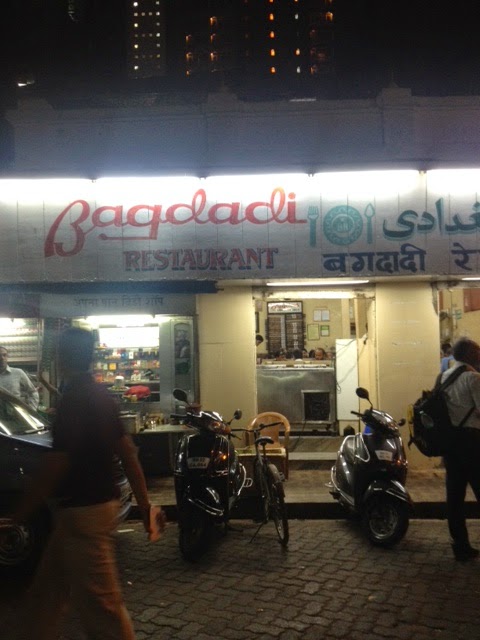
Bagdadi Restaurant is located in Colaba in the lane between Colaba Causeway and the Taj Mahal hotel - in the same lane as that no-frills drinking place and that overrated Kebab stall. Its exact year of origin is not known even to the present owners. Some say it's older than the nearby Gateway of India and the iconic hotel under whose shadow it exists. One online review even says its 128 years old. What is certain is that this one is a centurion and that it is thriving!

 
Mohammad Ibrahim Sheikh is the present owner of Bagdadi Restaurant and was kind enough to answer a few questions about the history of the place on a busy Tuesday night. It was Mohammad's great grandfather who started the restaurant a little more than a century ago. Since then the ownership of the restaurant has changed hands a few times before eventually coming back to Mohammad's family. The name Bagdadi may lead one to believe that the owners have an Iraqi or Middle Eastern lineage, but Mohammad explains that it is just a reference to the Persian/Iraqi influence on Indian Muslim cuisine in general and Mughal cuisine in particular.

 
While most Muslim eateries are known for their Kebabs, there are actually none on the menu at Bagdadi. It's all about the meat curries here. The menu has items written on wooden planks arranged on a wooden frame that looks as old as the restaurant itself.

 
While the meat curries at Bagdadi are great, the real star at this restaurant is its Tandoori Roti. King size and really crisp, they are rolled out of the Tandoor non-stop and you are sure to see a few at every table. I remember saying this to a friend once while describing the rotis at Bagdadi - "With these, you'll even eat turds"! Might be inappropriate to mention on a food blog, but I think you get the point.

 
The curries at Bagdadi come with chicken, mutton or beef. My pick of the lot is the Mutton Bhuna. It's got well-cooked chunks of mutton loaded with tomato and chilies and packs quite a punch. Needless to say, it goes really well with the Tandoori Roti.

 
Apart from the regular menu, the restaurant also has daily specials displayed on a separate board and the Thursday special is Chicken Patiala. This is a chicken leg cooked in a rich curry and is milder than the Bhuna but equally good.

 
Bagdadi also has Pulao and Biryani on the menu and the Mutton Biryani is surely worth a try. But while Biryanis in many restaurants tend to be too dry, at Bagdadi the problem seems to be the opposite. There is too much marinade - as much as the rice in fact. A bit more rice or a little less marinade in each portion and this would be a really good Biryani.

 
A century in operation and Bagdadi Restaurant is still going strong, remaining packed almost daily and justifiably so. Let's hope Mr. Mohammad Ibrahim Sheikh and his successors keep it going for another hundred. And the next time you're looking for a bite after a drinking session at that popular no-frills bar next door, skip that overrated Kebab house and head to Bagdadi!

https://www.zomato.com/mumbai/bagdadi-colaba

Monday, December 29, 2014

The gems of South Bombay vol 2 - Piccadilly

Lebanese is one of the most popular cuisines around the world, and not without reason. Lebanon's Mediterranean location and climate and Levantine origins and varied cultural influences have made its food naturally agreeable for people across the world. The Lebanese diaspora has brought its cuisine to wherever they have gone - Europe, the US and far flung places like Australia and even South America. Lebanese fast food joints with their inviting Shawarmas are as common in several countries in Europe as McDonalds and KFCs.

India has not been left untouched by the Lebanese restaurant phenomenon either. Shawarma joints started appearing in Bombay sometime in the 90s and the trend seems to have continued. Some of these are even chains operating in several Indian cities. However, as far as I'm concerned, the benchmark for Lebanese food has been set very high. While I've not been to Lebanon, three months in Europe as a student meant a lot of Lebanese food on the road. The best of the lot was, in fact, in Toulouse where I stayed - right across the street from our apartment. It was called 'El Dayaa' and was owned by Lebanese immigrants from Tripoli. I even wrote a post about it on this blog here.

Most Lebanese joints in Bombay leave a lot to be desired. This is especially true if you've eaten Lebanese in an 'authentic' restaurant abroad.  While most of these new restaurants seem to have worked on middle-eastern interiors and have fancy sounding Arabic names, the Shawarmas and Shish Tawouks are as Lebanese as Chicken Manchurian is Chinese. There is one exception though, one restaurant that pre-dates all its mediocre peers in the city. Lebanese is just one of the cuisines served here - the others being Iranian and European - yet it is what the restaurant is most known for. Not surprisingly, it is located in South Bombay and is the second restaurant to be featured in the ongoing series.

Piccadilly sits right at the mid-point of Colaba Causeway, opposite Electric House and the iconic Cusrow Baug. Hidden behind a row of hawkers, it's really easy to miss.


 Unfortunately, I have not been able to gather enough information on the history of the restaurant. Post 26/11, bars and restaurants in Colaba have turned extremely security-conscious (understandably) and I was reprimanded by the owner after taking the above picture as I entered the place one evening. I obviously couldn't quiz him about the origins of his restaurant after that.

I do know that Piccadilly was started many decades ago by Iranian immigrants and was much like some of the many Irani cafés in the city. Somewhere down the line, the menu was modified to cash in on the trend of western backpackers making Colaba Causeway a port of call on their trip through the country. Lebanese was one of the cuisines introduced during the revamp and the restaurant has never looked back since and is even featured on Zomato's 'legendary' collection.

I have been to Piccadilly many many times, and have tried a lot on their substantial menu, which spans several cuisines, Lebanese, Iranian and Western being the main ones. But for this post, I'll focus on the Lebanese food at Piccadilly - after all, that is what got it a spot on the series.

The Shawarma rolls are understandably the biggest draw at Piccadilly. The sandwiches are served with Chicken and Mutton Shawarma fillings inside a Pita wrap with Hummus, garlic sauce and fries. This is what the Mutton Shawarma sandwich looks like.

 
The sandwich is as good as it is simply because it is a sum of great parts - great pita bread, great hummus, great garlic sauce and obviously well-marinated roast meat. Once you've tried the Shawarma at Piccadilly, the others in the city will pale in comparison, that's for sure. It also scores extra points for the pickled cucumber, beetroot and chilies served with each portion!
 

Most of what is served as a sandwich at Piccadilly can also be enjoyed as a 'meal on a plate'.  This is a large portion of grilled meat served with garlic sauce, hummus, fries, salad and Khaboos bread. The pick of the lot is the Mutton Kebab plate.

 
Shawarmas and Kebabs are not all that you can eat at Piccadilly. Dazaz Mahashi is the Lebanese version of Biryani. But while most Biryanis are served with either chicken or lamb, this rice dish has both! It's diced chicken and mincemeat with brown sauce marinade in basmati rice, and it’s neatly served like this!
 

What I've described in this post is just some of the delectable Lebanese fare served at Piccadilly, but Iranian and Western portions of the menu are equally good - Zereshk Polo (Berry Pulao) and Baked Chicken being the must-haves.

Does sound like it's worth a visit no? So do like me when in Colaba and grab a window-side table at Piccadilly!

The address, reviews and addition info in the link below.

https://www.zomato.com/mumbai/piccadilly-1-colaba

Friday, October 31, 2014

The gems of South Bombay: Pradeep Gomantak

Working in South Bombay has its pains and its perks. Commuting time is long given its location at one end of the city. The rise of Lower Parel and BKC has made its office spaces less sought after. Having said that, 'Town' as it is popularly known, still retains a certain charm. Its British era buildings and heritage quarters make it a prettier part of the city than its northern counterparts. Several bars and pubs provide it with plenty of after-work entertainment options. It also has, in my opinion - and with that we come to the point - the best eating places in the city.

Town has always been home to a large number of restaurants. Many of these came into existence to cater to the needs of people working in its many offices. While these served staples, many others focused on fine dining given that South Bombay is also home to famously affluent residents called 'townies'. In recent times, some locations in the suburbs - Bandra in particular - have challenged South Bombay's undisputed title of the city's premier food district. Bandra has matched, and in some cases surpassed Town in bringing new cuisines and trendy eating places to the city. But when it comes to restaurants that deserve to be called 'institutions' - ones that serve faultlessly authentic cuisines at affordable prices and have stood the test of time (some are a century old) - Town wins hands down. Its countless hole-in-the-wall eateries serve cuisines as varied as Mughlai, Parsi and Keralite at affordable prices and definitely tip the scales in favor of South Bombay.

I have been working at Nariman Point for the past year and a half. Needless to say then that I've made full use of the opportunity to tick a lot off my bucket list. The list however is quite long and there are still some 'hidden gems' yet to be uncovered. But while the quest is on, I've covered enough to feature the best in a series of posts. I'm calling these 'The gems of South Bombay' and they are mostly blink-and-miss restaurants in the bylanes of Fort, Colaba, Kalbadevi and beyond. I've tried to cover various cuisines and restaurants in different parts of Town.

First on the list is a tiny restaurant in Fort called Pradeep Gomantak Bhojanalay. Gomantak cuisine is poorly understood, despite being fairly popular in Bombay. It is often described as having origins in coastal Maharashtra and is confused with Malvani cuisine. Let me set the record straight. Gomantak food comes from Goa and is the cuisine of the state's Hindu community. It differs from the more famous Goan Catholic cuisine in its use of tamarind and Kokum instead of vinegar and the absence of pork and beef among other things. Being a Goan Hindu myself, this is comfort food for me. In fact this blog was started after a particularly memorable visit to the legendary 'Anantashram Uphaar Griha', a Gomantak restaurant which unfortunately no longer exists.

Gomantak eateries were once very common in several neighborhoods of Bombay. They typically seat less than 30 people and the look is characterized by marble-top tables and menus scribbled on chalkboards. Meals are served on stainless steel plates and the Thali called 'Taat' in Konkani is the most common order. Over the years, many Gomantak restaurants (Anantashram being the prime example) have shut down for reasons like rising costs and shortage of suitable labor, while others like Highway Gomantak and Dadar Gomantak have been forced to adapt to changing times and in the process have ended up losing some of their authenticity. Few that remain offer the quintessential Gomantak canteen experience. Pradeep Gomantak Bhojanalay, situated in a small lane in Fort, is one of these. Started more than forty years back to cater to the then rapidly growing office crowd, the tiny restaurant has stood the test of time. Owned and operated by Mr. Amonkar and his family, the place sees long queues for weekday lunches, partly because of its limited seating capacity, but also due to its well-deserved popularity. So if you don't fancy waiting in a queue for an hour, its best to visit for dinner or on the weekend. This is what I did when I got there for dinner on a Monday night. As far as restaurants are concerned, Pradeep Gomantak defines the word small. It has barely six tables and can squeeze in a maximum of 30 people with great effort. The decor (or lack of it) has 'Gomantak Khanaval' written all over it! From the folding wooden door at the entrance and the sunmica topped tables to the open kitchen and the small wash basin in the corner, the look and feel of the place is as authentic as it gets.


As expected, dinner time was more relaxed at Mr. Amonkar's restaurant and I had only three other people for company. Gomantak eateries are known for their meat as well as fish preparations. While the norm is to order the Thali, individual portions of meat curry and fried/curried fish are also served. The menu in true Khanaval (traditional canteen) style, was scribbled on a chalkboard.


One look at the prices and you know that you have to eat at a place like this to realize how countless other restaurants in the city cheat you when it comes to serving fish.

I wanted to try fish as well as meat, so I ordered the Mutton Thali and a portion of fried pomfret. The Thali arrived quickly and was the typical Gomantak 'Taat'. It had two small mounds of rice, a mutton curry, two chapatis, green chutney with chopped onions and lemon, a plain curry to go with the rice and a bowl of the customary Solkadi. This is what it looked like.


The mutton was cooked to perfection and had meat, fat and bone in perfect proportion. The curry for the rice is a common feature in the Gomantak Thali and is typically called Surva. The version served at Pradeep Gomantak is special because, while it is not served with fish, fish skin and bones are used to make it. This may not sound very appetizing, but it does give the curry a great flavor and you realize this when the first morsel mixed with rice goes down.

The pomfret arrived when I was half done with the Thali and was medium sized and fried whole.


There was something I had learned while eating at Anantashram once and it came in handy here. I had not touched the chutney, onions and lemon and had saved these for the pomfret. Sprinkle salt and pepper on the onions and squeeze the lemon in. This and the green chutney is the perfect accompaniment for Goan style fried fish. The pomfret was super fresh, certainly better than what is served at most self-proclaimed 'seafood restaurants' that use the tag to rip a hole in your pocket. Finshing the meal with the Solkadi, I burped with satisfaction only a hearty meal like this can bring.

With very few of its kind surviving in Bombay, Pradeep Gomantak Bhojanalay is doing a great job of keeping the cuisine alive in the city and ensuring that the Gomantak Khanaval tradition survives. It is especially important for us Goenkaars, for whom its victuals are comfort food. I hope the Amonkar family keeps the restaurant going in its current authentic and undiluted form for many generations to come. Kudos!

If you find yourself in the Fort area close to mealtime, make sure you drop in. Here is its listing on Zomato for the address, additional information and reviews.

http://www.zomato.com/mumbai/pradeep-gomantak-bhojanalaya-fort

For more gems from South Bombay, watch this space!