Monday, September 7, 2015

The gems of South Bombay vol 6 - Hotel Grant House

One way (among many others) to categorize restaurants in Bombay - and the rest of the country - is those that are 'multi-cuisine' and ones that specialize in serving food from a particular country or region. The subject of this post however, is a restaurant that cannot be slotted in either category. And while the ongoing series exclusively features restaurants in South Bombay that do a fabulous job of specializing in regional cuisines, this one is an exception. And it finds a place on this series of posts despite this oddity, only owing to the quality and consistency of the food it serves.

Hotel Grant House is conveniently located - right next to Haj House below the southern end of the JJ flyover and a walking distance from CST station. It was started by a certain Mr. Laxman Varma from Hyderabad, way back in 1951. It was simply called 'Police Canteen' at the time, owing to the policemen at the neighboring station, who were regulars there. The present name of the establishment has a bit of the city's history associated with it. It is named after Sir Robert Grant, who was the governor of Bombay in the 1830's and actually lived in the building that stood at the spot before the present structure came up!

In its early days, the menu at Police Canteen was simple and consisted of staples like omelets, scrambled eggs (Bhurji) and of course a Bombay favorite, the Kheema Pav. In fact, the super-popular version served at the restaurant today owes its recipe to early patrons whose frequent suggestions were used in experiments in the kitchen till the present (stellar) avatar evolved! Over the years, seafood preparations and other meat dishes were added to the menu. The proprietors are from Andhra Pradesh and their fiery native cuisine has also made an appearance on the menu in recent years.

The view of the restaurant from the outside has no-frills written on it in bold. And the interiors confirm that impression as well. There is no air-con, seating is plain and the kitchen is visible from the dining area. Clean but plain is how you would describe the look-and-feel.


 The decor of the restaurant however, is in complete contrast to the bloke who currently manages it. Shekhar Varma is Mr. Laxman's son and presently runs the restaurant's operations along with his brother. He is smartly dressed, speaks perfect English and is also quite media-savvy. In fact, he has appeared on Kunal Vijaykar's popular show 'The Foodie' where the restaurant's Kheema was featured.

 
From what I've said so far about the food at Grant House, it's clear that the place is hard to categorize on the basis of cuisine. The menu is a combination of Bombay classics, seafood specialties from the Maharashtra coast and some items from the owners' native Andhra. I've tried a few things in each of these categories and it’s all been really good. Let's look at this as a six-ball over by a deadly pace bowler - the likes of Dale Steyn and Mitchel Johnson - and see if we can get you out.

Ball 1 (Out swinger) - Kheema Pav

Kheema Pav is served all over the city for breakfast, lunch and dinner and is one of its favorite foods. Naturally, the title for the city's best Kheema is likely to be hotly contested. Most people would include Kyani & Co. at Kalbadevi, Stadium Restaurant at Churchgate and Olympia Coffee House at Colaba in their list of the city's best Kheema pavs. The Grant House version, with its use of coconut and long whole green chilies is different from the ones mentioned above, but it would be right up there if a taste test was held. They do other mincemeat recipes like Kheema Ghotala (with egg) and Kheema Bheja mix and they are pretty good too.

 
Ball 2 (Bouncer) - Surmai Chutney Fry

This one is definitely a bouncer! Green Chutney is usually stuffed in fish like Pomfret or Mackerel. Surmai (Indo-Pacific King Mackerel) with its meaty fillets can't really be stuffed. It's usually just coated with rava and fried or used in a curry. And this is where the folks at Grant House have displayed some remarkable creativity. The Surmai fillet is slathered with green chutney along with the usual salt-turmeric-chili powder mix and the whole thing is then coated generously with rava to hold it all together. The shallow fried Surmai Chutney Fry is sure to surprise and delight its first-time eater.

 
Ball 3 (The Slower One) - Bombil Fry

It's not called Bombay Duck for nothing. It's found in the shallow waters around the city in large numbers and is a favorite with the city's fish-eaters. It's a pain to cook though. It's slippery and full of moisture, which means it has to be drained well before frying. It's hard to get that right - and Grant House does. Its Bombil Fry is perfectly crisp on the outside and soft on the inside and is served with a green chutney (wonder if it's the one used for the Surmai)


 Ball 4 (In swinger) - Andhra Fish Curry

It's a shame the folks at Grant House have not included more items from their native Andhra cuisine on the menu. If this fiery fish curry is anything to go by, they definitely should. It stings your palette, and gives you a hard time the next morning, but will definitely make you come back asking for more. It's perfect with steamed rice.

 
Ball 5 (Off-cutter) - Desi Chicken

Its broilers everywhere and very few places serve country fowl these days. Grant House is one of them and they do a really good job. This one is pretty fiery as well and is best accompanied by Chapattis.


 Ball 6 (Yorker) - Mixed Seafood Pulao

Another example of some creativity at work. Most places would just serve a Prawn Pulao and be done with it. These guys have added crabmeat and other assorted fish and turned it into a favorite on the menu. Fine touches like the use of spring onions make it one of the best combinations of seafood and rice one is likely to find in the city.

 
Gotcha? Why am I even asking.

Address, reviews and other details - https://www.zomato.com/mumbai/hotel-grant-house-cst

Thursday, August 20, 2015

The gems of South Bombay vol 5 - Shree Thaker Bhojanalay

Gujaratis (or Gujjus as they are popularly known) have always been one of the most prominent communities of Bombay. In terms of influence on the city's culture, they are second only to Maharashtrians. Even the city's Hindi dialect (Bambaiyya) has a large number of Gujarati loan words. Known primarily as a business community, they wield significant economic clout in the city. Most areas in Bombay have significant Gujju populations, but Kandivali, Ghatkopar and parts of South Bombay are undisputed Gujarati bastions.

When not chasing the next lucrative business idea, Gujjus are known for traveling the world (does the phrase 'Patel snap' ring a bell?) and dining out. On any given weekend in the city, one is likely to find Gujarati families queuing up at the popular food stalls or occupying majority of the tables at most restaurants. So much so, that most restaurants in the city have now expanded the vegetarian sections in their menu (most Gujaratis are vegetarians) and some even have separate Jain menus.

But while South Indian, Indianized Mexican and Italian are the most popular weekend cuisines among the Gujaratis of Bombay, how about their own food? While an authentic Gujarati meal is best experienced at a dining table in a Gujarati household, there is one good option if you want to try the cuisine while eating out. That is the Gujarati Thali. As the name suggests, it’s a one-person meal (obviously vegetarian in this case), which in most cases is an eat-all-you-can combination of Rotis, Dals, rice and countless sides and desserts.

There are a large number of restaurants offering the Gujarati Thali in Bombay. And while there is a restaurant serving the Gujju Thali in most localities in the city, the largest number can be found in South Bombay. Not surprising, given the fact that many of its areas like Walkeshwar, Girgaon and Kalbadevi are Gujju-dominated. While which one of these is the best can be a matter of great debate among Gujjus and non-Gujjus alike, my vote goes to a certain 'Shree Thaker Bhojanalay'.

Thaker has been at the top of the ratings on restaurant review sites and TripAdvisor for several years now. And while that is not the last word on the quality of food at a restaurant, a stellar score across websites after  thousands of ratings and hundreds of reviews makes the case in its favor really strong. In fact, for the longest time, Thaker was Mumbai's restaurant #1 on TripAdvisor.

Finding this place is nothing short of a treasure hunt though. Tucked away in a tiny alley of Kalbadevi called Dadiseth Agiary Lane, this one is hard to find even with the help of Google Maps.
I have been here several times and it’s only after three or four visits that I could get here without stopping to ask for directions. But don't let this deter you - the reward at the end of this search is good enough! What's more, once you're in the right lane, a significant landmark in the city's history greets you on your way to the restaurant - Dadiseth Agiary, which lends its name to the lane, is the oldest Zoroastrian fire temple in the city!


The restaurant itself is on the first floor of one of the typical chawl buildings in the area and you have to spot the board announcing its presence at the building entrance if you don’t want to miss it. As you climb the creaking stairs, framed proofs of accolades gathered over the years greet you.


The air-conditioned and brightly lit interiors are in complete contrast to the dark corridors one passes through before entering. The staff, despite being super-busy at mealtimes seems to be trained in Gujarati hospitality, which makes dining here an especially pleasant experience.

Ordering can't get any simpler than at Thaker's. They have no menu as the standard Thali of the day is the only thing they serve. You get seated and a stainless steel plate with as many as ten bowls is dropped on your table. At this point it’s all empty and you have no idea of the assault that is about to begin.


Over the next five minutes, the large plate and the bowls begin to fill up. It’s hard to keep track of all that is served but here's most of it.

The Sides

- Kachori
- Dhokla
- Pakoda
- Chutneys (I could count at least four)
- Aachar (Pickle)
- Salad
- Farsan
- Papad
- Dahi Vada

The vegetable curries

- Potato
- Cabbage
- Mixed lentils
- Greens

The Dals

 - The typical Gujju sweet variant
- The standard savory dal

The Rotis (Three to four types including Puris)

The desserts

- Puran Poli
- Aamras


That is what it looks like after one round by the servers. And while it looks like a lot already, what the picture does not capture is the virtual (and persuasive) conveyer belt that the waiters form as they keep refilling each and every item on the plate. It's all really good and it’s only after you fear having no place for dessert, that you finally ask them to stop. And there's still that heap of rice to finish.


By the time you've finished the desserts, getting up to go to the wash basin looks like a daunting task. But as you drag yourself back through the dark corridor and dingy staircase, you know for sure that you will return to subject yourself to this again

Thursday, March 5, 2015

The gems of South Bombay vol 4 - The Kerala restaurants of Fort

South Bombay is mostly inhabited by communities which migrated to the city in its early days. Maharashtrians who came from other parts of the state and who have not moved to the suburbs, Gujarati business families, affluent Marwaris and Punjabis, Goan and East Indian Catholics and the Muslims of the Byculla to VT belt. Keralites or 'Mallus' as they are commonly called, have never formed a major part of its population.

Mallu-owned restaurants serving authentic Kerala cuisine are a big part of the crowded food scene of the Fort area of South Bombay though. Part of this can be explained by the demand created by Keralites working in offices in the area. But a bigger reason for these restaurants coming into existence was the mad rush of youth from Kerala stopping over in Bombay on their way to work in the Middle East. While that steady clientele has now dwindled, with major airlines now flying to the Gulf directly from Kerala, many of the restaurants have survived to this day. When I counted last, there were at least seven Kerala restaurants in the Fort area, some of them located right next door to each other and still managing to draw packed houses at lunch. I have eaten at most of these but will introduce the three that I like best in this post.

Hotel Deluxe takes some finding, located in a small lane behind the Citibank building in Fort. An easy way to look for it is to get to the more famous Mahesh Lunch Home and enter the adjacent lane. It serves a long list of Kerala specialties in addition to a killer Sadhya meal for lunch. It shares the lane with its arch rival 'Taste of Kerala' which is its main competitor for the title of the best Kerala restaurant of Fort.

 
One fun aspect of Kerala cuisine is pairing the breads with the many curries/stews/roasts. Idiyappam is a bunch of steamed rice vermicelli usually served for breakfast with chutneys. It is my favorite among all the various sources of starch that are part of the Kerala food universe. Hotel Deluxe is kind enough to serve Idiyappams all day and I was more than glad to order it one evening with their superb Chicken Roast. I don't know if this is the ideal combination, but it sure worked for me. The fiery hot Roast loaded with green chilies and curry leaves was perfectly complimented by the light Idiyappams.

 
 Sadhya means banquet in Malayalam and is a term used to describe a vegetarian meal served on a banana leaf. It is a feast served on festivals like Onam and occasions like weddings and religious ceremonies. The number of items served on the leaf varies along with the significance of the occasion. At Hotel Deluxe, the biggest Sadhya is served on Onam and getting a seat at the restaurant during the festival is near impossible. A smaller but sufficiently elaborate Sadhya is served on Sundays, while a basic Sadhya with the essentials is on the menu on weekdays for lunch.

I tried the scaled down Sadhya at Hotel Deluxe on a weekday lunch with two of my colleagues and had absolutely no complaints. Here is all that was served

Boiled brown rice
Thoran (sauted cabbage with grated coconut)
Avial
Pineapple Pachadi (a sweet Khichadi)
Olan (a preparation made with pumpkin, coconut milk and ginger)
Sambar
Rasam
Garlic Pickle
Puliyinchi (a paste made of ginger, tamarind, green chilies and jaggery)
Pappadam
Parippu Pradhaman (green gram Payasam)


 This mini version was quite the feast as well, what with the waiters constantly refilling items on the leaf. Wonder what Sundays and Onam are like!!

While the Sadhya lunch is vegetarian, the fish and meat items can be ordered separately and I really wanted to try Karimeen (Pearl Spot), a fish which is very popular in Kerala and is found in large quantities in its backwaters. The whole fried Karimeen at Hotel Deluxe is loaded with spicy marinade and costs more than anything else on the menu, but is worth a try.
 

Taste of Kerala is the only-so-slightly more upmarket next door neighbor to Hotel Deluxe. The menu here is very similar to the neighboring eatery - the banana leaf vegetarian lunch and a long list of meat and fish specialties - but it also serves Chinese and North Indian fare in a bid to attract a wider clientele. It obviously makes sense to ignore these new additions and head straight 'South'.

Appams are almost synonymous with Kerala cuisine and are usually paired with a stew. At Taste of Kerala, the Appams are made fresh at a counter in the dining area itself. And they are best enjoyed with the Fish Naadan Curry. This is basically chunky pieces of Kingfish (Surmai) cooked in a curry made with thick coconut milk. Using your Appam to soak the last bits of curry is a joy any Kerala food experience would be incomplete without.

 
Taste of Kerala serves some beef preparations as well, but you will not find these on the menu. The reason according to them is to avoid spooking customers. Ask one of the waiters however, and they'll list the Taste of Kerala beef specialties in characteristic style. Beef Chilly is a big favorite among Keralites and is commonly served in the very popular toddy shops in the state. Taste of Kerala serves a great version and it is best had with the flaky, layered Kerala Parotta.

 
Tapioca, known as Kappa in Malayalam is a popular source of food in Kerala. It is eaten as an accompaniment with meat and fish curries and chips are also made out of it.  Kappa Biryani is a dish unique to Kerala, and is made by combining tapioca with beef. The Kappa Biryani at Taste of Kerala is better than what I've tried elsewhere.

 
After all that spice and cholesterol, there can be few better ways to end your meal than a bowl of Payasam. And at Taste of Kerala, they have variety when it comes to Payasam. There is Parippu Pradaman (Moong Dal Payasam), Semiya Payasam (Vermicelli), Ada Pradaman (made with jaggery, coconut milk and rice flakes) and my favorite the Paalada Payasam. This one is similar to the Ada Pradaman, but is made with milk and sugar instead. It is served in a glass and comes loaded with almonds and raisins and chunky rice flakes (Adas)....get me a couch already!!

 
Hotel Fountain Plaza is yet another Kerala restaurant in the Fort/Fountain area. While it is not rated as highly as Hotel Deluxe and Taste of Kerala, it ranks higher than the other restaurants in the vicinity. It is easy to find, located in a lane off DN Road and is known for serving Mappila specialties.

 
Pathiri is a steamed rice pancake, similar to the Mangalorean Neer Dosa and finds its origin in the Mappila cuisine of North Kerala. It is regularly served as Iftar food during the month of Ramadan in Kerala. At Fountain Plaza, the Pathiris are served in a generous helping of four per plate for close to nothing. At the waiter's recommendation I tried it with their Chicken Kerala Curry.

 
While the curry was good, I was left with one Pathiri at the end of it. I asked the waiter if I could order a small portion of something to finish it with, and he got me a small bowl of this plain curry.
That thing packed so much taste, it proved to be the best accompaniment to the Pathiri, even better than the chicken.

 
If there is one thing that this post makes clear, it is the fact that the Kerala restaurants of Fort cover a great variety of the state's cuisine. From toddy shop specialties and Onam Sadhya dishes to home-style cooking and Iftaar favorites, they've got it all. The offices may be moving North and the Gulf-bound youth may not be passing through Bombay anymore, but with food like this on offer, these places will never run out of fans.

Details of the restaurants covered in the post:

Hotel Deluxe: https://www.zomato.com/mumbai/hotel-deluxe-fort

Taste of Kerala: https://www.zomato.com/mumbai/lalit-refreshment-taste-of-kerala-fort

Hotel Fountain Plaza: https://www.zomato.com/mumbai/hotel-fountain-plaza-fort

And a few more in the Fort area.

Bombay Restaurant: https://www.zomato.com/mumbai/bombay-restaurant-fort

Rahmaniya: https://www.zomato.com/mumbai/rahmaniya-restaurant-fort

Wednesday, January 28, 2015

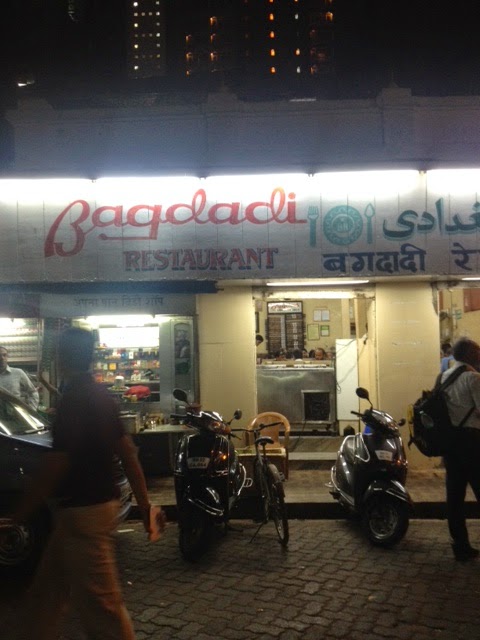
The gems of South Bombay vol 3 - Bagdadi Restaurant

The history of  Bombay as a major city dates back to 19th century British rule - relatively short in comparison to several other cities in the country like Delhi, Hyderabad and Lucknow. Consequently, the culinary culture of the city is also younger and has its origins in regions of the country from which large numbers of people migrated to it. So while the these significantly older cities can boast of descendants of medieval court chefs still plying their trade in present day restaurants, it is not something you're likely to come across in Bombay.

There are however, some very old restaurants in the city. South Bombay, or Town as it is popularly known, was the part of the city that was settled the earliest and this is where restaurants came up first. Most of the oldest eating places in the city can still be found in Town. And there are a handful that have been around for more than a century. That the quality of food in these establishments is stellar should not come as a surprise - that is the least it would take to survive for that long. And how can a series of posts on the best restaurants in South Bombay be complete without one featuring a centurion? So here goes!

Bagdadi Restaurant is located in Colaba in the lane between Colaba Causeway and the Taj Mahal hotel - in the same lane as that no-frills drinking place and that overrated Kebab stall. Its exact year of origin is not known even to the present owners. Some say it's older than the nearby Gateway of India and the iconic hotel under whose shadow it exists. One online review even says its 128 years old. What is certain is that this one is a centurion and that it is thriving!

 
Mohammad Ibrahim Sheikh is the present owner of Bagdadi Restaurant and was kind enough to answer a few questions about the history of the place on a busy Tuesday night. It was Mohammad's great grandfather who started the restaurant a little more than a century ago. Since then the ownership of the restaurant has changed hands a few times before eventually coming back to Mohammad's family. The name Bagdadi may lead one to believe that the owners have an Iraqi or Middle Eastern lineage, but Mohammad explains that it is just a reference to the Persian/Iraqi influence on Indian Muslim cuisine in general and Mughal cuisine in particular.

 
While most Muslim eateries are known for their Kebabs, there are actually none on the menu at Bagdadi. It's all about the meat curries here. The menu has items written on wooden planks arranged on a wooden frame that looks as old as the restaurant itself.

 
While the meat curries at Bagdadi are great, the real star at this restaurant is its Tandoori Roti. King size and really crisp, they are rolled out of the Tandoor non-stop and you are sure to see a few at every table. I remember saying this to a friend once while describing the rotis at Bagdadi - "With these, you'll even eat turds"! Might be inappropriate to mention on a food blog, but I think you get the point.

 
The curries at Bagdadi come with chicken, mutton or beef. My pick of the lot is the Mutton Bhuna. It's got well-cooked chunks of mutton loaded with tomato and chilies and packs quite a punch. Needless to say, it goes really well with the Tandoori Roti.

 
Apart from the regular menu, the restaurant also has daily specials displayed on a separate board and the Thursday special is Chicken Patiala. This is a chicken leg cooked in a rich curry and is milder than the Bhuna but equally good.

 
Bagdadi also has Pulao and Biryani on the menu and the Mutton Biryani is surely worth a try. But while Biryanis in many restaurants tend to be too dry, at Bagdadi the problem seems to be the opposite. There is too much marinade - as much as the rice in fact. A bit more rice or a little less marinade in each portion and this would be a really good Biryani.

 
A century in operation and Bagdadi Restaurant is still going strong, remaining packed almost daily and justifiably so. Let's hope Mr. Mohammad Ibrahim Sheikh and his successors keep it going for another hundred. And the next time you're looking for a bite after a drinking session at that popular no-frills bar next door, skip that overrated Kebab house and head to Bagdadi!

https://www.zomato.com/mumbai/bagdadi-colaba